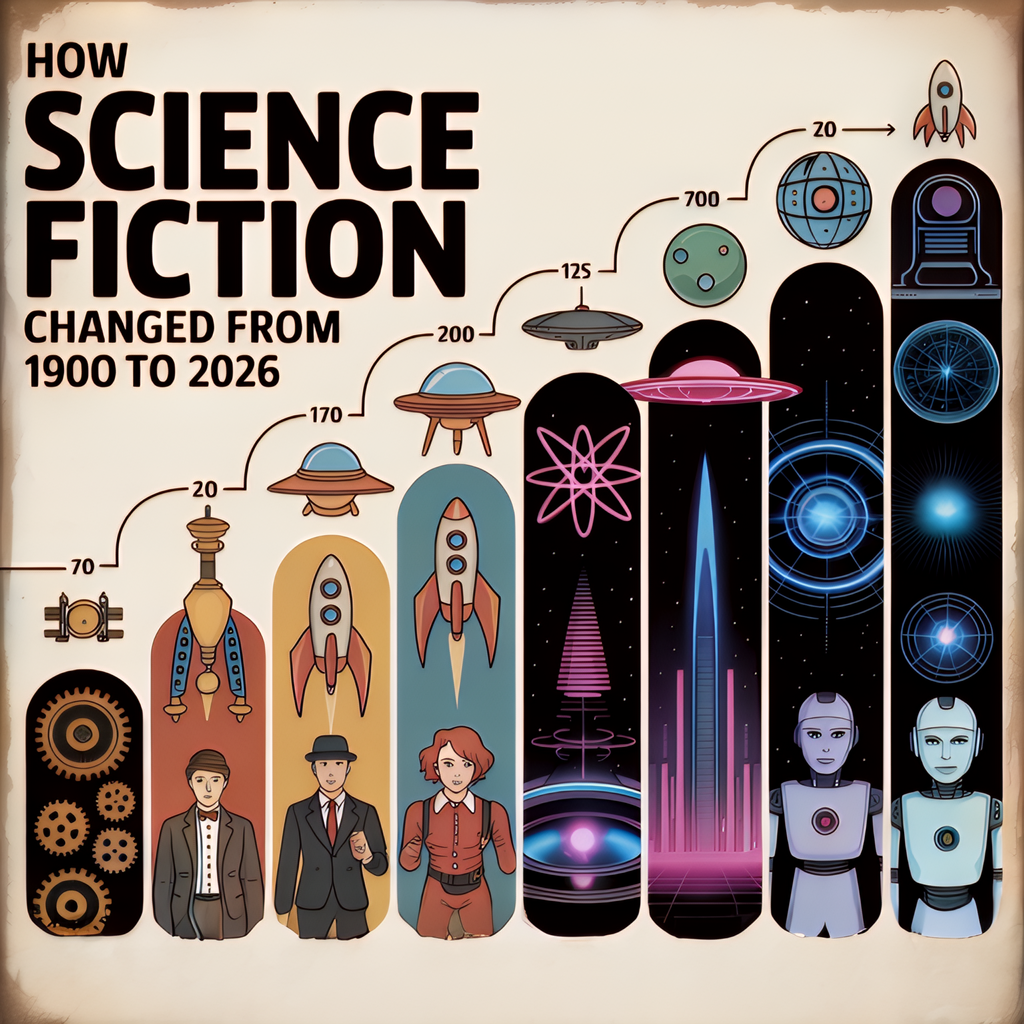
Science fiction is NOT just about rockets, robots, aliens or planets far away. It can reveal to people what they want to be, what they fear they could be, and what they hope to be. Science Fiction Changed so with that The World Changed. As the technology, war, politics, climate and culture changed, writers had new questions to answer.
Science Fiction, in the early 1900s, had to ask itself “What can Man create?” By 2026, it asks questions, some of which are much deeper, like “Should humans build this?” and “What happens if our own creations are smarter than us?” Science fiction is one of the most thrilling genres in literature, film, TV, and games.
Science fiction is based on the influence of actual or potential science on individuals and society, therefore, it always adapts to the times. It was popularized by Hugo Gernsback, who first published Amazing Stories in 1926 and helped to define science fiction as a genre.
Why Science Fiction Reflects Human Progress and Fear
Science fiction is a reflection of the dreams of every generation, but it’s also the reflection of the fears. Paper writers were filled with enthusiasm about machines and envisioned what kind of devices they could create to alter the lives of humans. When there was a fear of war, writers envisioned ruined cities, alien invasions and weapons of destruction.
As people discovered that progress could aid humanity, but also have a negative impact on it, Science Fiction changed. Machines could save lives, but it could take jobs. A spaceship can travel in the stars, and a rocket can carry a bomb. Hope and fear were the ingredients of powerful science fiction.
The Link Between Scientific Discovery and Storytelling
Scientific discovery gives writers new tools for imagination. When electricity, radio, airplanes, nuclear energy, computers, the internet, and artificial intelligence entered public life, science fiction writers quickly turned them into stories. They did not simply explain these discoveries. They asked what these discoveries could do to human relationships, freedom, identity, and survival.
Science Fiction Changed because writers followed science, but they also challenged it. They asked questions scientists, governments, and companies sometimes avoided. What happens when people trust machines too much? What happens when humans leave Earth? What happens when technology grows faster than morality?
What This Timeline Reveals About the Future
There’s a distinct pattern in the history of science fiction. The genre rides along the fears and dreams of the society. It starts with invention and exploration, then war, space travel, the digital world and now today’s conundrums, Artificial Intelligence, Climate Change, Identity, and Reality.
Science Fiction evolved from mere adventure tales to one of the most incisive means of comprehending the contemporary world. It now foretells gadgets too as well as studies human decision-making.
Early 20th Century 1900 to 1930
The Birth of Modern Science Fiction
In the years 1900 to 1930, it was in the years of early modern science fiction.It was the years of early science fiction from 1900 to 1930. Authors covered time travel, alien worlds, futuristic cities, secret worlds and strong inventions.Many stories focused on big ideas more than deep characters. Readers wanted wonder. They wanted to imagine what science could make possible.
Science Fiction Changed during this period because the world had started to feel modern. Trains, factories, electricity, telephones, and early cars changed daily life. People saw machines everywhere, so writers imagined even greater machines. The future suddenly felt close.
Influence of H. G. Wells and Jules Verne
H. G. Wells and Jules Verne were two of the most prominent figures in early science fiction. Adventure was a favorite theme of Verne’s, which involved submarines, moon travel and trips to unknown places. In his darker and more philosophical approach, Wells examined the notion of power. He also wrote about time travel, alien invasion, invisibility and human evolution.
Their stories helped readers see science as more than facts in a textbook. Science became a doorway into danger, discovery, and imagination. These authors proved that science fiction could entertain readers while also making them think.
Industrial Revolution and Machine Imagination
The Industrial Revolution had already changed how people lived and worked. Machines filled factories. Cities grew. Transportation became faster. People felt amazed, but they also felt nervous. Could machines improve life, or would they control it?
Science Fiction Changed because machines became symbols. A machine could represent progress, greed, power, or danger. Writers used inventions to ask whether humans could control what they created.
Common Themes of Time Travel, Space, and Invention
Early science fiction loved big concepts. Time travel allowed writers to visit the future or the past. Space travel allowed them to imagine life beyond Earth. Invention stories allowed ordinary people to become explorers, heroes, or warnings.
These stories often focused on “what if” questions. What if a person could travel through time? What if humans reached the moon? What if an invention gave someone too much power? Those questions still drive science fiction today.
Writing Style and Idea Focused Narratives
Back then, sci-fi stories leaned hard on concepts, tossing aside feelings for facts. Instead of diving into characters’ heads, authors would fixate on gadgets or wild scientific guesses. Even if that approach now seems dated, it built something lasting underneath. The foundation of the genre? Laid down by those early blueprints.
Science Fiction Changed later when writers added more character depth, sharper dialogue, and stronger emotional conflict. Still, the early idea-focused style gave science fiction its bold personality.
Early Predictions That Became Reality
Earlier, some old sci-fi stories visualized gadgets that humans actually built later on. Picture this, authors scribbling ideas like flying to planets, talking by screen, smart tools, and diving deep below oceans. Not every guess hit the mark, yet somehow those stories stretched minds past today’s limits. What stuck wasn’t accuracy, but a nudge to wonder what’s next.
What made it powerful was how it pushed minds ahead of machines. Because dreams often came first, long before anything got built.
The Golden Age 1930 to 1950
Expansion and Scientific Accuracy
The period from the 1930s to the 1950s became known as the Golden Age of science fiction. During this time, writers placed more focus on scientific logic. Stories still had adventure, but they also tried to make the science feel more believable.
Science Fiction Changed as readers demanded smarter stories. They wanted plots that followed rules. They wanted technology that made sense. This pushed writers to think carefully about physics, engineering, robotics, and space travel.
Rise of Pulp Magazines and Sci-Fi Popularity
Among cheap pages and wild plots, pulp magazines brought sci-fi to just about everyone. With price tags light enough for pocket change, these reads served thrills while opening doors for unknown authors. Rocket ships blasted across front art, sometimes tangled with beasts or helmeted explorers lost on odd planets. Strange civilizations glowed under fake stars, drawn bold and bright to catch eyes passing by.
Hugo Gernsback shaped science fiction into something people could see and name. Because of the magazines, fans found each other to talk back on argued points and eagerly waited for the next issues to keep the conversation going.
Contributions of Isaac Asimov and Arthur C. Clarke
Isaac Asimov and Arthur C. Clarke’s bold ideas helped a lot to shape serious science fiction. Clarke focused on space, intelligence and the future of human evolution, whereas Asimov often followed stories about the robots and society. Their thoughtful work gave ambition to the science fiction genre.
Science Fiction Changed because authors like Asimov and Clarke made the genre feel bigger than adventure. They treated science fiction as a place for serious ideas about civilization.
Introduction of Robotics and Space Exploration
Robots became one of the most important ideas of the Golden Age. Writers asked whether robots could serve humans, replace humans, or become human in their own way. Space exploration also became central. Rockets, planets, colonies, and alien contact filled the imagination of readers.
These ideas mattered because people were already thinking about the future of technology. Science fiction gave those thoughts a dramatic shape.
Impact of World War II on Science Fiction
After World War II, science fiction started feeling different. Just because the governments had turned science into a tool for destruction, fear crept into stories about progress. When nuclear bombs exploded, they didn’t just destroy cities, but also shattered the idea that machines always make life better.
Science Fiction Changed after the war because writers could no longer treat progress as purely exciting. They had to deal with fear, responsibility, and survival.
Shift Toward Logical and Scientific Storytelling
Back then, science fiction stories trusted logic more than anything else cause problems had scientific solutions based on facts. Cleverness mattered most and muscles took a back seat. People who built things and explored space become central characters.
This style inspired many young readers to become interested in science. It also showed that imagination and reason could work together. Not only did it spark curiosity, but it blended creative thinking with logical thought.
Mid-Century Shift 1950 to 1970
Nuclear Fear and Alien Invasion Stories
The mid-century shift from 1950 to 1970 saw science fiction become even darker due to the stories that fed fear of global destruction because of Nuclear weapons.
Alien invasion story plots just felt like fantasy, and control slipping away felt familiar. Enemies beyond Earth mirrored those on maps, unseen but always looming.
Science Fiction Changed as fear replaced simple wonder. Writers still imagined the stars, but they also imagined ruined cities, radiation, and societies pushed to the edge.
Influence of the Space Race and Global Tension
The Space Race gave science fiction new energy. The United States and the Soviet Union competed to reach space, and people watched real rockets leave Earth.
NASA began in 1958 and pushed human spaceflight, science, and aeronautics forward, while the Space Race made space exploration part of everyday public imagination.
Science fiction suddenly felt less impossible. The moon, once a dream in old stories, became a real destination. This changed how people read and watched science fiction.
Rise of Dystopian and Apocalyptic Themes
Out of nowhere, the dystopian tales started carrying weight back then. Control over thinking that came from the made-up governments dreamed up by authors. Freedom? Often stamped out in those fictional places they built. War or tech gone wild, those tore entire worlds apart on the page. A warning hid between the lines, aimed at how people organize themselves in groups.
Science Fiction Changed because the future no longer looked automatically better. Writers began to say, “A future can be advanced and still be terrible.”
Sci-Fi as Political and Social Commentary
Science fiction became a powerful way to discuss politics and society. Writers used aliens, future governments, and distant planets to talk about racism, censorship, war, propaganda, gender, and power.
This helped the genre grow up. It could still entertain, but it could also challenge readers. A story about another planet could really talk about Earth.
Transition from Optimism to Fear-Based Narratives
Earlier science fiction often celebrated invention. Mid-century science fiction questioned it. Writers did not reject science, but they asked people to use it wisely.
Science Fiction Changed because humanity had gained the power to destroy itself. That fact gave the genre a new seriousness.
Cyberpunk Era 1970 to 1990
Emergence of Cyberpunk and Digital Worlds
The 1970s to 1990s introduced a sharper, darker style called cyberpunk. Cyberpunk stories often showed high technology mixed with broken cities, crime, poverty, hackers, and powerful corporations.
Instead of shiny futures, readers saw neon streets and people fighting systems that controlled them.
Science Fiction Changed when computers entered the center of the genre. The future moved from outer space to digital space.
Influence of Philip K. Dick
Philip K. Dick had an impact on the discussions surrounding reality, memory, self-identity, and synthetic organisms. The 1968 book entitled Do Androids Dream of Electric Sheep by Philip K. Dick became one of the seminal texts in relation to discussions surrounding artificial beings and humanity.
This is because Philip K. Dick did not simply explore the capabilities of machines but rather humanity itself.
Themes of Artificial Intelligence and Corporate Control
Cyberpunk often showed corporations as more powerful than governments. It imagined worlds where companies controlled information, bodies, cities, and even dreams. Artificial intelligence became more mysterious and dangerous.
Science Fiction Changed because the enemy was no longer always an alien or a monster. Sometimes the enemy was a system. Sometimes it was a company. Sometimes it was the technology people used every day.
Rise of Virtual Reality Concepts
VR became an important concept in the world of cyberpunk. In cyberpunk novels, people would travel to VR worlds and live different lives.
Once considered futuristic, these concepts now seem normal since we are all familiar with spending time on our computers and phones.
Cyberpunk was ahead of its time in predicting the psychological impacts of digital technologies.
Human Identity in a Technological Society
Cyberpunk asked big personal questions. Are you still human if machines rebuild your body? Are your memories real if someone can edit them? Are you free if algorithms shape your choices?
Science Fiction Changed by turning inward. It no longer only explored planets. It explored the mind, the body, and the self.
Mainstream Explosion 1990 to 2010
Impact of Films Like The Matrix
Between 1990 and 2010, sci-fi stopped being niche. Films led the charge, though TV shows pulled equal weight. Comics added depth while video games let people live inside those worlds.
Online spaces gave fans places to gather, argue, imagine. Then came The Matrix which is not just a movie, but a shift. Action drove it forward, sure, yet ideas about control, machines, what’s real held attention longer. Philosophy hid in fight scenes. Rebellion wasn’t shouted; it was coded into choices.
Science Fiction Changed because visual storytelling became more powerful than ever. Audiences did not only read the future. They saw it, heard it, played it, and debated it online.
Internet and Global Audience Expansion
The internet changed science fiction fandom. Fans could discuss theories, share reviews, write fan fiction, and build communities across countries. A person no longer needed a local club or magazine to join the conversation.
This global audience changed what creators made. Stories had to speak to many cultures, many fears, and many kinds of viewers.
Blending of Sci-Fi with Action and Philosophy
Science fiction became easier to mix with other genres. It blended with action, horror, romance, comedy, crime, superhero stories, and philosophy. This made it more flexible and more popular.
Science Fiction Changed because it stopped sitting in one corner of entertainment. It became part of almost everything.
Growth of Fan Theories and Online Communities
Online communities changed how people experienced stories. Fans paused scenes, studied clues, compared timelines, and created theories. This made science fiction more interactive.
Writers noticed this. They created deeper worlds, hidden details, and complex timelines because they knew audiences would analyze them.
Evolution of Visual Storytelling
Better visual effects allowed films and shows to create worlds that earlier generations could only imagine. Space battles, alien cities, digital realities, and futuristic machines looked more believable.
This helped science fiction reach people who may not have read the books. It also made the genre a major force in global pop culture.
Modern Era 2010 to 2026
Artificial Intelligence and Machine Learning Themes
From 2010 to 2026, artificial intelligence became one of science fiction’s biggest themes. Earlier stories often imagined robots as servants or enemies. Modern stories ask more complex questions. Can AI create art? Can it feel? Can it make moral choices? Can it replace human work?
Science Fiction Changed because AI stopped feeling distant. People now use real AI tools in school, business, design, writing, coding, and entertainment. That makes AI stories feel personal.
Multiverse and Nonlinear Storytelling Trends
Modern science fiction often plays with timelines, parallel universes, memory loops, and alternate versions of people. These stories reflect a world where people constantly ask, “What path could my life have taken?”
The multiverse idea also gives creators more freedom. They can explore identity, regret, choice, and consequence in exciting ways.
Climate Change and Eco Science Fiction
Climate change has become a major subject in modern science fiction. Eco science fiction, often called climate fiction or cli-fi, imagines flooded cities, extreme weather, food shortages, climate refugees, and new ways to survive. The Climate Fiction Prize describes climate stories as a way to help people understand climate threats and possible change through fiction.
Science Fiction Changed because the future now feels connected to the planet’s health. Writers no longer only ask whether humans can reach other worlds. They ask whether humans can protect this one.
Ethical Questions Around Technology
Modern science fiction focuses strongly on ethics. A story may ask whether people should edit genes, upload minds, build conscious machines, colonize Mars, or let algorithms make decisions.
These questions matter because many of these technologies now exist in early forms. Science fiction helps readers practice moral thinking before the future fully arrives.
Influence of Real AI and Emerging Tech
Real AI, robotics, biotech, space companies, surveillance systems, and virtual worlds now influence science fiction directly. Writers no longer need to invent everything from zero. They can look at today’s news and push it a few steps forward.
Science Fiction Changed because the gap between fiction and reality has become smaller. A story that once sounded wild can feel realistic within a few years.
Key Themes That Have Evolved Across Time
From Exploration to Survival
Early science fiction often focused on exploration. Characters traveled to the moon, Mars, the future, or the center of the Earth. They wanted to discover. Modern science fiction still explores, but it often focuses on survival.
Science Fiction Changed because humanity’s biggest questions changed. People now worry about climate, war, inequality, AI, privacy, and social collapse. The genre follows those worries.
From Machines to Conscious Intelligence
In older stories, machines usually worked as tools. Later, robots became characters. Today, artificial intelligence often becomes a mind with goals, emotions, or rights.
This shift matters because it changes the role of humans. If machines can think, create, and choose, people must ask what makes human life special.
From Outer Space to Inner Psychology
Science fiction once looked mostly outward. It explored planets, galaxies, aliens, and spaceships. Modern science fiction also looks inward. It explores trauma, memory, identity, loneliness, and perception.
Science Fiction Changed because readers now expect emotional depth. They want big ideas, but they also want characters who feel real.
Changing Role of Humanity in Sci-Fi
In early stories, humans often stood at the center of the universe. They explored, invented, conquered, and solved problems. In modern science fiction, humans often seem smaller and more vulnerable.
This does not make the genre weaker. It makes it more honest. It reminds readers that intelligence without wisdom can become dangerous.
Fear vs Curiosity Across Generations
Every generation brings a different balance of fear and curiosity. The early 1900s felt curious about machines. The Cold War feared destruction. The cyberpunk era feared corporations and computers. The modern era fears climate collapse, AI control, and loss of truth.
Science Fiction Changed with each generation because each generation asked different questions about the future.
Modern Science Fiction Books and Emerging Voices
Classic vs Contemporary Sci-Fi Literature
Classic science fiction often focused on inventions, space travel, logic, and large-scale ideas. Contemporary science fiction still uses those elements, but it adds more diverse voices, cultures, identities, and emotional stories.
Modern writers explore who gets included in the future. They ask whose stories matter. They show futures shaped by different languages, communities, histories, and struggles.
Unique Themes and Narrative Style
Contemporary science fiction uses many styles. Some books feel poetic. Some feel fast and cinematic. Some mix science fiction with mythology, politics, mystery, or family drama. This variety makes the genre richer.
Science Fiction Changed because readers no longer expect one type of science fiction. They want many futures, many voices, and many ways to imagine what comes next.
Target Audience and Genre Placement
Science fiction now reaches children, teens, adults, gamers, movie fans, literary readers, and academic audiences. Young adult science fiction often explores identity, rebellion, friendship, and survival. Adult science fiction may explore politics, philosophy, technology, and social systems.
This wide reach proves that science fiction has become more than a niche genre. It has become a major language for talking about change.
Common Mistakes in Understanding Sci-Fi Evolution
Oversimplified Timelines
One common mistake is treating science fiction history as a simple straight line. The genre did not move neatly from one style to another. Many styles overlapped. Space adventure, dystopia, cyberpunk, climate fiction, and AI stories can all exist at the same time.
Science Fiction Changed in waves, not in a single clean path. Old ideas often return with new meaning.
Ignoring Cultural and Technological Context
Another mistake is ignoring the real world behind the stories. You cannot fully understand alien invasion stories without Cold War fear. You cannot fully understand cyberpunk without computers and corporate power. You cannot fully understand modern AI fiction without real machine learning tools.
Science fiction grows from its time. To understand the story, readers should also understand the world that produced it.
Lack of Thematic Depth in Analysis
Some people reduce science fiction to gadgets and special effects. That misses the point. The best science fiction uses technology to explore human choices.
A robot story may really discuss freedom. A space story may really discuss loneliness. A climate story may really discuss responsibility. A multiverse story may really discuss regret.
Conclusion
From 1900 to 2026, science fiction traveled a long road. It moved from invention stories to space dreams, from nuclear fears to cyberpunk cities, from internet-age blockbusters to modern stories about AI, climate, identity, and reality.
Science Fiction Changed because humans changed. Our tools became stronger. Our fears became bigger. Our dreams became more complicated. Yet the heart of the genre stayed the same. Science fiction still asks, “What if?” That question keeps the genre alive.
The best science fiction does not only predict the future. It prepares people for it. It teaches readers to question progress, protect humanity, and imagine better choices before the future arrives.