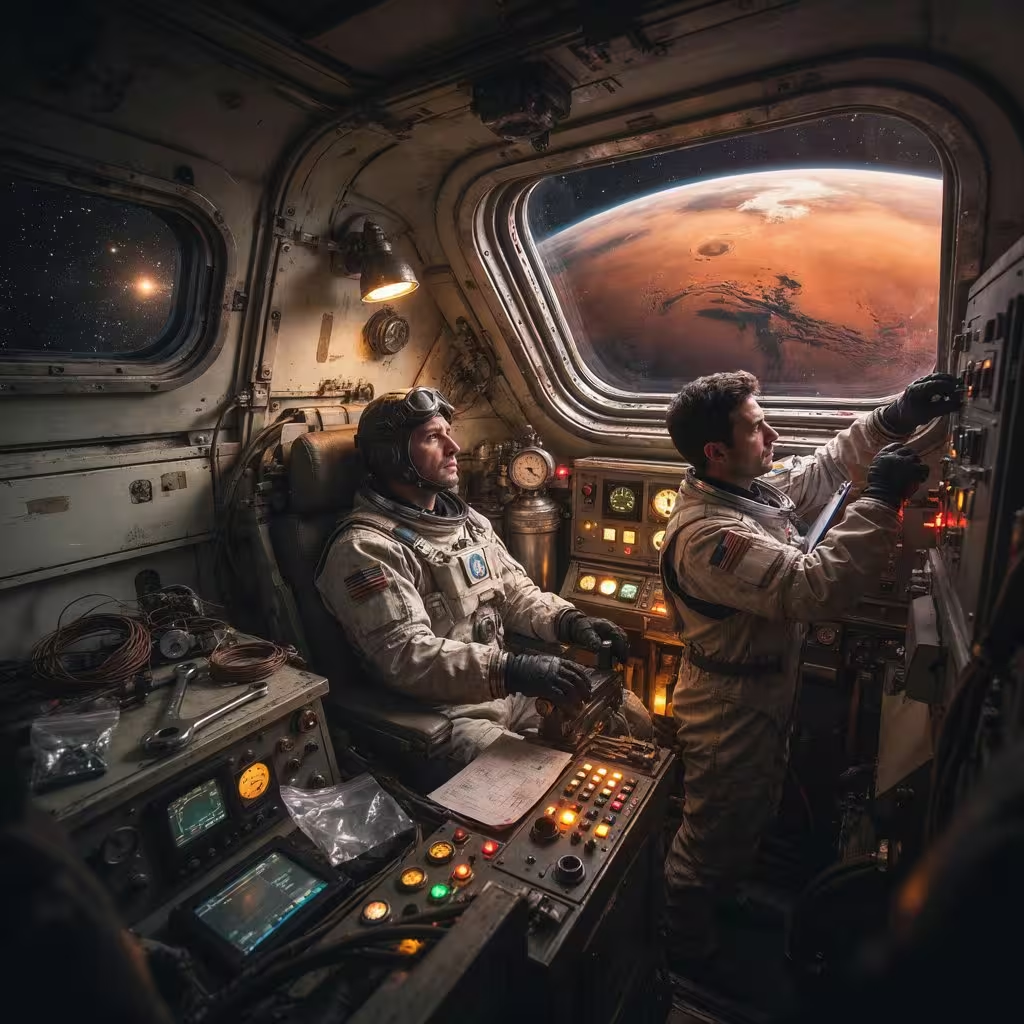
Imagine reading a story where astronauts travel through space, but every part of their journey follows rules that could actually exist in the real world. Their spacecraft needs fuel, their oxygen supply can run out, and even a small mistake can become a serious problem.
That is where hard science fiction, or hard sci-fi, comes in.
Unlike stories that use science mainly as a backdrop, hard sci-fi puts science and technology close to the center of the story. It asks questions such as, “Could this really work?” and “What would happen if humans actually built this?”
You do not need to be a scientist to enjoy it. In fact, hard sci-fi can be a great place for new readers because it turns big scientific ideas into exciting stories about people, problems, and possibilities.
What Is Hard Sci-Fi?
Hard sci-fi is a type of science fiction that gives special attention to real scientific ideas, believable technology, and logical explanations.
A hard sci-fi story might explore what happens when humans build a spacecraft that travels to Mars. Instead of simply saying the spacecraft can fly there, the author may think about its fuel, speed, food supply, radiation protection, and the time needed for the journey.
The science does not always have to be completely correct. Authors may imagine things that do not exist yet. What matters is that the scientific ideas usually have some connection to known science or are explained in a way that feels logical.
For example, an author might imagine a new type of space engine. The engine may be fictional, but the story could still explain how it works and what limits it has.
That attention to detail is one of the main things that makes hard sci-fi special.
What Makes a Story Hard Sci-Fi?
Several features can make a science-fiction story feel like hard sci-fi. The most important one is the role science plays in the story.
Scientific Accuracy and Real-World Principles
Hard sci-fi often starts with real scientific concepts. Authors may use ideas from physics, biology, chemistry, astronomy, or engineering to build their stories.
For example, a story about life on another planet might consider the planet’s gravity, atmosphere, temperature, and available water. These details can affect how humans survive there.
Some stories go very deep into science, while others keep the explanations simple. The goal is not always to teach a science lesson. Instead, science helps make the fictional world feel believable.
Realistic Technology and Future Ideas
Hard sci-fi often imagines technology that could possibly exist in the future.
A writer might imagine advanced robots, powerful computers, artificial intelligence, or improved spacecraft. The technology can be fictional, but it usually follows a set of rules.
Think about a smartphone. If someone in a story creates a new phone that can run for ten years without charging, a hard sci-fi writer might need to explain where that energy comes from.
This focus on futuristic technology makes readers wonder what parts of the story could one day become real.
Detailed Worldbuilding
Worldbuilding means creating the setting in which a story takes place. In hard sci-fi, science often helps shape that setting.
A planet is not just a place with strange-looking mountains. Its gravity, atmosphere, weather, and distance from its star may all affect life there.
The same applies to spacecraft. The design may depend on how much fuel it carries, how the crew gets food and water, and how the ship protects people from dangerous radiation.
These details can make the fictional world feel like a place that could actually exist.
Problems Solved Through Science
In many hard sci-fi stories, science is not just background information. It helps characters solve problems.
An astronaut might need to repair a broken machine with limited tools. A scientist may need to figure out how to grow food in an unusual environment. A crew might have to calculate how much oxygen they have left.
These situations make the story exciting because the characters cannot simply use magic to fix everything. They have to understand the problem and find a logical solution.
Hard Sci-Fi vs. Soft Sci-Fi
The easiest way to understand the difference between hard and soft sci-fi is to look at what the story focuses on.
Hard sci-fi usually gives more attention to science, technology, and how things work. Soft sci-fi may focus more on people, society, politics, emotions, or philosophical questions.
Neither approach is automatically better. They simply give readers different experiences.
Hard Sci-Fi
In hard sci-fi, scientific ideas often have a strong connection to the plot. If you removed the scientific problem, the story itself might change significantly.
For example, a story about astronauts surviving on Mars may depend on realistic problems such as limited oxygen, food, water, and communication.
Soft Sci-Fi
Soft sci-fi usually spends less time explaining scientific details. Instead, it may use a futuristic setting to explore human behavior, society, relationships, or big questions about life.
For example, a story might take place on a distant planet but focus mainly on how different groups of people live together.
The line between the two is not always clear. Some stories combine both styles. A book can have realistic science while also spending plenty of time exploring human emotions and society.
What Are Some Examples of Hard Sci-Fi?
Hard sci-fi can be found in books, movies, and television. Some stories are more technical than others, so beginners can choose examples that match their interests. Hard sci-fi is only one part of the broader science-fiction genre, which includes stories built around space exploration, futuristic technology, social change, and other possibilities.
Classic Hard Sci-Fi Examples
Arthur C. Clarke’s 2001: A Space Odyssey is often associated with science-focused science fiction. It explores space travel, artificial intelligence, and human development while giving serious attention to scientific ideas.
Isaac Asimov’s Foundation is another important science-fiction work, although it also focuses heavily on society and human behavior. It shows why science fiction can sometimes fit into more than one category.
Robert A. Heinlein’s The Moon Is a Harsh Mistress also explores technology, life away from Earth, and the practical challenges of building a society on the Moon.
These older works helped shape many ideas that later science-fiction writers explored.
Modern Hard Sci-Fi Examples
Andy Weir’s The Martian is a popular example for new readers. The story follows an astronaut who becomes stranded on Mars and has to use science and engineering to stay alive.
The interesting part is that the main character cannot simply wait for help. He has to solve problems involving food, water, shelter, equipment, and communication.
Books such as Project Hail Mary, also by Andy Weir, use a similar approach by combining an exciting adventure with scientific problem-solving.
These books show that hard sci-fi does not have to feel like a textbook. It can still have humor, danger, mystery, and strong characters.
Is Hard Sci-Fi Always Scientifically Accurate?
Not necessarily.
This is an important point for new readers. Hard sci-fi does not mean that every scientific detail must be perfect.
Some ideas may be impossible with today’s technology but could be imagined as future possibilities. Other stories may take a known scientific idea and push it further than scientists currently believe is possible.
There is also a difference between being scientifically accurate and being scientifically plausible.
A scientifically accurate story follows what we currently know. A scientifically plausible story may imagine something new while still trying to follow reasonable scientific principles.
For example, an author could invent a new spacecraft engine. Scientists may not have built such an engine, but the writer can explain its limits, energy needs, and effects in a logical way.
That is often enough to make the story feel like hard sci-fi.
Why Do People Enjoy Hard Sci-Fi?
Hard sci-fi attracts readers for many different reasons. Some enjoy the science, while others simply like stories that make them think.
It Makes the Future Feel Possible
One of the most exciting parts of hard sci-fi is the feeling that something fictional might one day become real.
Reading about space stations, advanced robots, or new medical technology can make you wonder what the world might look like decades from now.
It Encourages Curiosity
A good hard sci-fi story can make readers curious about real science.
You might start a story knowing very little about Mars and finish it wanting to learn how Mars differs from Earth.
That is one reason scientific concepts can be so useful in fiction. They can introduce complicated ideas in a fun and memorable way.
It Turns Science into Part of the Story
In some stories, science is simply information in the background. In hard sci-fi, it can create the actual problem.
A limited oxygen supply, a damaged spacecraft, or a dangerous planet can become a major part of the plot.
The science is not just something characters talk about. It can determine what they can and cannot do.
It Makes Readers Think
Hard sci-fi can also raise bigger questions.
What happens if humans live on another planet? How might artificial intelligence change society? What could happen if humans discover life somewhere else?
These questions can stay with readers long after they finish the story.
How Can You Tell If a Book Is Hard Sci-Fi?
You can usually get a good idea by asking a few simple questions:
- Does the story depend heavily on science or technology?
- Does the author explain how important technology works?
- Do scientific rules create limits or problems for the characters?
- Does the story consider the real-world consequences of its ideas?
- Would changing the science significantly change the story?
If you answer “yes” to several of these questions, the book may have strong hard sci-fi elements.
You can also check the book description, reviews, or author interviews before starting. But remember that genres often overlap, so you do not need to put every book into one exact category.
Is Hard Sci-Fi Difficult for New Readers?
The word “hard” can make the genre sound intimidating, but hard sci-fi is not always difficult to read.
Some books contain pages of technical explanations. Others use simple language and explain only the science needed for the story.
A beginner does not need to understand every equation or scientific idea. You can enjoy a story first and learn more about the science later.
If a book becomes too technical, there is nothing wrong with moving to another one. The goal is to enjoy reading, not pass a science exam.
How to Start Reading Hard Sci-Fi
Starting with the right book can make a big difference.
Start With an Accessible Story
Choose a story that explains its scientific ideas clearly. Books such as The Martian are popular starting points because the central survival problem is easy to understand even when the science becomes detailed.
Pick a Topic You Already Enjoy
Think about what interests you most. You might enjoy space exploration, robots, artificial intelligence, medicine, planets, or engineering.
Starting with a familiar interest makes unfamiliar scientific ideas easier to follow.
Don’t Worry About Understanding Everything
You do not need to stop every few pages to search for an explanation.
If you understand the main problem and can follow what the characters are trying to do, you can keep reading. You can always research interesting ideas later.
Explore the Science After Reading
If a story mentions something that catches your attention, look it up afterward.
You might discover that some parts of the story are based on real science while others are fictional. That can make the reading experience even more interesting.
Final Thoughts on Hard Sci-Fi
Hard sci-fi is science fiction that takes science and technology seriously. It uses real ideas, logical rules, and believable possibilities to build exciting stories.
That does not mean every story has to be perfectly accurate or filled with complicated technical details. A good hard sci-fi story simply makes you believe that its world has rules and that those rules matter.
For new readers, the best way to understand the genre is to try a story and see what you enjoy. You might love the scientific puzzles, the realistic future, or simply the feeling of discovering what humans could achieve.
And if you finish a book wondering, “Could this actually happen someday?” then hard sci-fi has probably done exactly what it set out to do.